A sticky key can be very frustrating, not only in ruining your playing experience but also in ruining your satisfaction with making music. Whether you are practicing scales or playing your favorite tunes, a sticky key quickly gets in the way.
Fortunately, there are ways to resolve sticky key issues with a little knowledge and proper care. At Chara, we have encountered many pianos with sticky key issues, and we are here to help you with resolving your sticky key problem.
Understanding the Common Causes of Sticky Piano Keys
In order to properly address your sticky key problem, it is important to first understand what causes it. There are several common causes of sticky keys, including dirt and debris accumulation, humidity, and worn-out key bushings. In some instances, sticky keys can be caused by issues with the action mechanism, where the felt bushings compress over time, leading to misalignment of key pins.
By understanding what causes sticky keys, we can then move ahead to learning how to fix a sticky key on a piano!
Step-by-Step Guide to Safely Removing the Piano Action
For any sticky key situation, start with a gentle cleaning. If cleaning the key does not resolve the problem, then the issue lies deeper, and the solution involves removing the piano action. Piano owners often notice piano keys sticking when deep internal issues arise that surface cleaning can’t address.
To remove the piano action, the fallboard, which is the cover for the keys, needs to be removed. To remove the fallboard, the fallboard hinges or clips have to be located, and once they are located, the rest will follow.
Start with the action assembly, which is usually located at the back of the keys, and depending on the type of piano, remove the few screws holding the assembly; in some models, the assembly needs to be lifted straight up. The action assembly is a sensitive part of the piano, as it holds the felt hammers and the springs, so be careful here. If you don’t feel confident, contact a pro for repairs.
Cleaning and Lubricating the Key Pins and Bushings
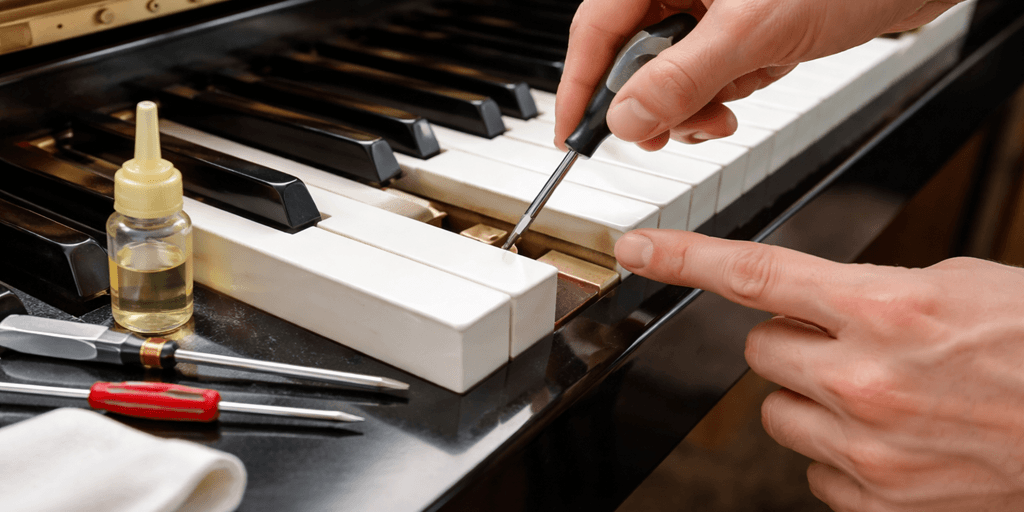
Once the action is removed, the key pins and the bushings can be inspected for any dirt, corrosion, and excessive wear. A soft, dry cloth can be used to clean the key pins, and any grime causing the problem can be removed. However, if the bushings are compressed, they might have to be replaced; this requires the assistance of a professional.
For issues with sticky piano keys, a key pin lubricant can be used to resolve any problems associated with excess friction. Although this lubricant works wonders, one has to be very cautious not to over-lubricate the key pins, as this might cause more dust to stick, causing the problem all over again.
When to Seek the Help of a Professional Piano Technician
While some of the problems that may arise from sticking keys can be handled by an amateur, there are instances when the problem is too complex and thus requires the services of a professional. For example, when the key is not improving after cleaning and lubrication, then the problem is complex and could do with some expert hands.
If you notice keys sticking on piano even after multiple attempts at cleaning, it’s definitely time to call in an expert. We always recommend that our students seek the help of a professional piano technician. Whether you’re an adult learning for the first time or a parent of a child attending special needs programs, piano maintenance is key for continued motivation.
Keep Your Piano in Peak Condition
It’s not always difficult to fix a sticky key, and it can be done to ensure that your piano is in good working condition; you can then enjoy your music even more. With the understanding of what causes it and how you can access the inner parts of the piano, you can be sure that your piano is in good condition for years to come. And when you need to, remember to call the pros for peace of mind!

Shanna Kirkpatrick Logo