
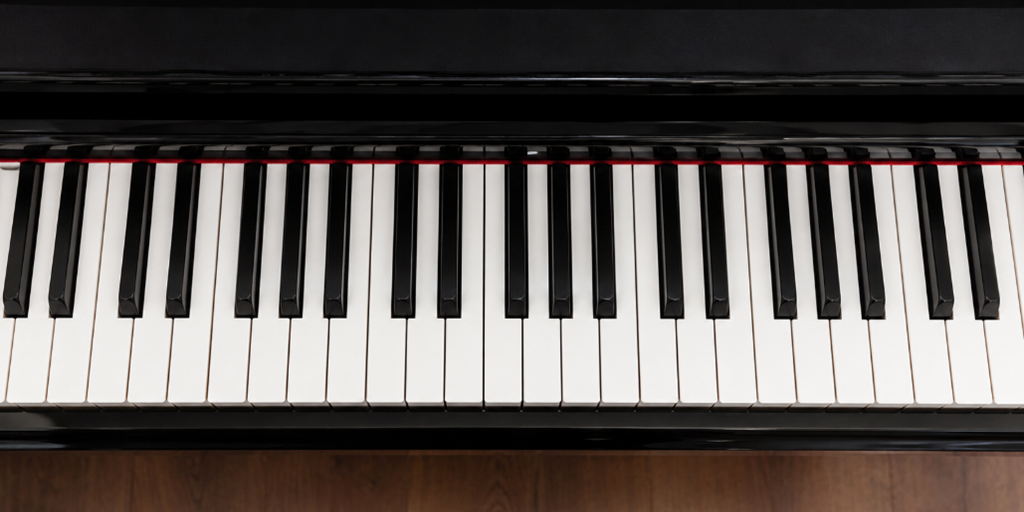
It may seem overwhelming when you first come across a large array of piano keys. There is a wide variety of sounds produced by the keyboard ranging from thunder-like rumble to bright chime. However, to those who wish to learn music lessons, it is crucial to comprehend the structure of the piano keyboard.
Our music studio at Chara often sees students sitting in front of a piano, staring at the keyboard in confusion. However, the thing is that this layout is not random and confusing at all. Actually, the piano keyboard represents a very logical structure which makes music theory quite visible to the eye. Once you get familiar with the basics of piano keyboard structure, playing the instrument will become much easier for you, especially with guidance from the best piano teachers in Pearland, TX.
The Number of White and Black Keys
There are several ways you can take a closer look at the piano keyboard. First, let us consider the structure of the standard 88-key acoustic piano keyboard.
Structure of a Standard Acoustic Piano Keyboard
A regular acoustic piano usually includes 88 keys regardless of its type: an upright piano or a grand piano. The number of 88 keys was established in the late 19th century when manufacturers understood that this number allows to cover all distinct pitches perceived by a human ear.
Of all the 88 keys, 52 of them are white keys while 36 are black ones. Thus, if you count them, you will see that the total sum of 88 is achieved. However, apart from that, if you have ever wondered how many white keys on a piano, the answer is that the 52 white keys and 36 black keys provide 7 full octaves plus some additional keys above and below the whole piano board.
We recommend our students to count the keys just to check it themselves. When you realize that there are 52 white keys and 36 black keys, you are able to imagine the whole layout of the keyboard as a defined area rather than an endless one.
Roles and Arrangement of White Keys in Musical Scales
The white keys of the keyboard are used as the basis of Western music theory. They represent natural notes of the musical alphabet which include A, B, C, D, E, F, and G. After reaching G, the musical alphabet is repeated in the next octave.
How White Keys Create the Basis of Music Theory
If you try to play only white keys starting from C and ending on the next C, you will play C major scale. It is the most fundamental scale in Western music, and it does not include any black keys. The reason is that the white keys are broad and located right in the front of the piano keyboard. That is why beginners can easily press them and play the most basic notes.
Usually, we start our lessons with the white keys to develop finger skills and understanding of basic intervals without worrying about difficult hand positions, especially when explaining how many keys on a piano are white.
The Visual Guide Provided by Black Keys
The black keys not only represent a certain part of the piano keyboard but also give you a visual guide to this instrument. The arrangement of 36 black keys is alternating in twos and threes. This arrangement helps you find each note on the keyboard easily. For example, if you need to find note C, you should find two black keys and the white key left to them.
The black keys represent the sharps and flats. By altering the natural notes by using black keys, we can change the emotional coloring of the music. Without black keys, we would be limited in our possibilities to transpose a piece of music to another key in order to adjust it to the singer’s voice or to create tension and resolution in our pieces.
FAQs
Do All Pianos Have Exactly 88 Keys?
Though 88 keys represent the standard amount of keys for acoustic pianos and professional digital pianos, you will probably face other numbers. Beginner electronic keyboards include 61 or 76 keys to make the instrument less bulky and cheaper to manufacture. Though such number of keys is enough for early lessons, we recommend our students to learn to play using all 88 keys of the piano in case they want to play classical and jazz pieces.
Why Are The Piano Keys Colored White And Black?
The main reason is the historical usage of different materials. In the past, the natural keys were usually coated with ivory while the raised keys were made of dark ebony wood. Thus, the strong contrast between white and black keys allows you to instantly distinguish different notes in fractions of seconds. Now, manufacturers produce pianos with white and black keys made of durable plastics that do not harm animals.
Are The Black Keys Physically Harder To Play Than The White Ones?
The black keys are narrower and located further back than the white ones, thus requiring a little bit more effort to be played. However, they are not physically harder to play. Besides, many pianists believe that pieces written with a lot of black keys are better to be played since they correspond to the natural shape of a human hand.
Your Next Steps on the Piano Keyboard
Knowing that there are 52 white keys on a piano and 36 black keys in the piano keyboard is the first step you should make towards understanding the basics of music theory. Once you understand that there is a repetition of natural notes, sharps, and flats in the piano keyboard, you will see all the scales, chords, and pathways for your favorite songs.
We always enjoy helping our students to navigate through this interesting structure of the piano keyboard. So, if you feel ready to start learning to play the piano, contact us and book your first lesson!